


National Garden Scheme helps fund world’s first rooftop critical care unit garden
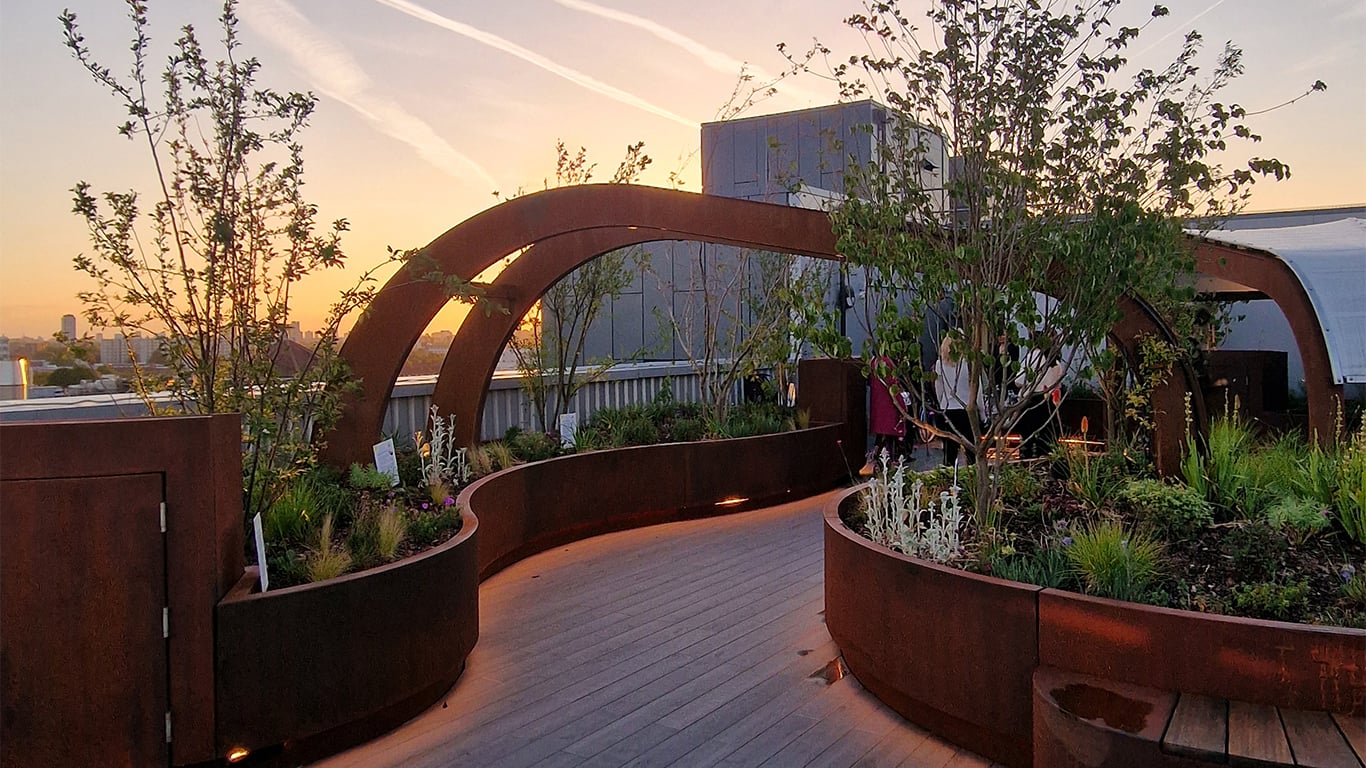
On Wednesday 20 May, Chief Executive Dr Richard Claxton attended the official opening of the Rooftop Garden at the critical care unit (CCU) at King’s College Hospital, London – a project that the National Garden Scheme part-funded.
“I’m so proud that the National Garden Scheme has supported such an important and innovative garden,” he says.
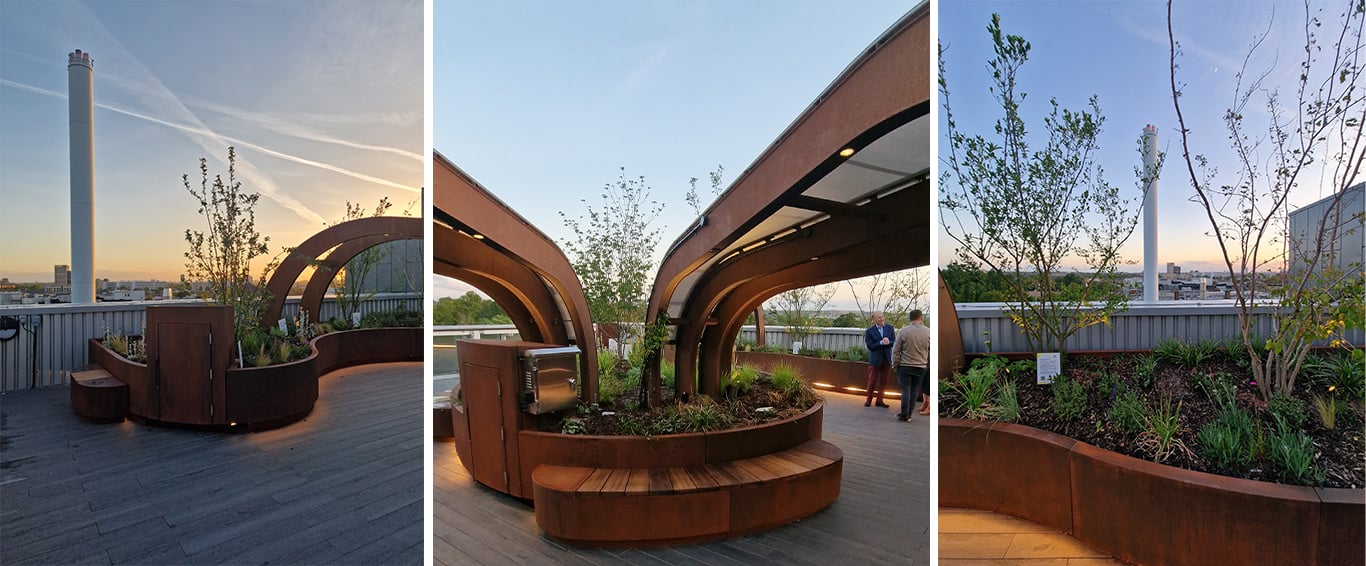
In the shadow of the hospital’s helipad, but with panoramic views across South London and the green space of nearby Ruskin Park, this is the first rooftop critical care unit garden in the world. The floor below has seen recent expansion of the unit to 60 beds – and of these patients at least four at any one time can now travel up onto the roof in a lift, allowing these patients, among the most unwell in the hospital, to spend time in the garden. Through a web of connections under the decking special weatherproof boxes house all the connectivity, gases, electrics and IT networks that are needed to enable their care to continue here, immersing patients in a healing green space of fresh air and clear skies – a massive contrast to the clinical environment of the unit below.
“As well as partial shelters and screening around a central pavilion structure of Corten steel, the planting of multi-stem specimen trees, shrubs, grasses and perennials allows the patient to connect with nature in its biophilic design,” adds Richard. “Balustrades of clear glass allow a view from the bedside straight down into the tree canopy, glades and community garden of Ruskin Park. The planting is deliberately at bed or chair level, and is rich in aromatic herbs like Thyme and Rosemary, tactile perennials like Stachys byzantina, as well as climbers such as Trachelospermum jasminoides the star jasmine, which will give an amazing scent as it flowers on the arches and the canopy.”
Natural light helps counter the disorientation and delirium so commonly experienced in a critical care unit environment. The intention is to provide a protective and restorative space for calm and decompression – a direct and deliberate contrast to the hospital environment with its sensory overload and intense stress.
The project has been 10 years in the making and is the brainchild of Consultant Dr Tom Best. Postponed first by COVID-19 and later on by fundraising difficulties, the ground-breaking design was led by the late Professor Nigel Dunnett and supported by Sarah Price.
“It was a real sadness that Nigel was unable to be there to see this, one of his final projects, completed. He passed away only a few weeks before the official opening. His was an extraordinary legacy even before this garden was completed, but it will surely come to be seen as one of his most influential designs,” says Richard.
Tom was himself recovering from surgery at the opening, but was supported by the Trust’s Chief Executive Professor Clive Kay, Dr Phil Hopkins, Lina Christopoulou, Deputy General Manager for Critical Care, as well as his family.
Tom and Phil, along with the whole clinical team, will perform research on the impact of this garden on patients’ journeys. They will look at the impact of this beautiful outdoor space on markers such as heart rate, delirium, vitamin D levels as well as impact of the garden on length of admission, and patients’ progress in physical, cognitive and psychological aspects of their recovery.
The bulk of the fundraising fell to the King’s College Hospital Charity, and the National Garden Scheme was delighted to contribute with a grant of £37,828 to support the planting, under our Gardens and Health grants scheme.
For more about the National Garden Scheme’s Gardens and Health programme
click here